



Musée d’Orsay Must-See Paintings: A Guide to the Highlights
Musée d'Orsay holds the world's most important collection of Impressionist painting, with rooms filled with works by Monet, Renoir, Degas, and Van Gogh, alongside earlier and later movements.
This guide brings together the must-see paintings, with the stories behind them and the artists who created them. You arrive at the museum knowing what to look for and what not to miss.
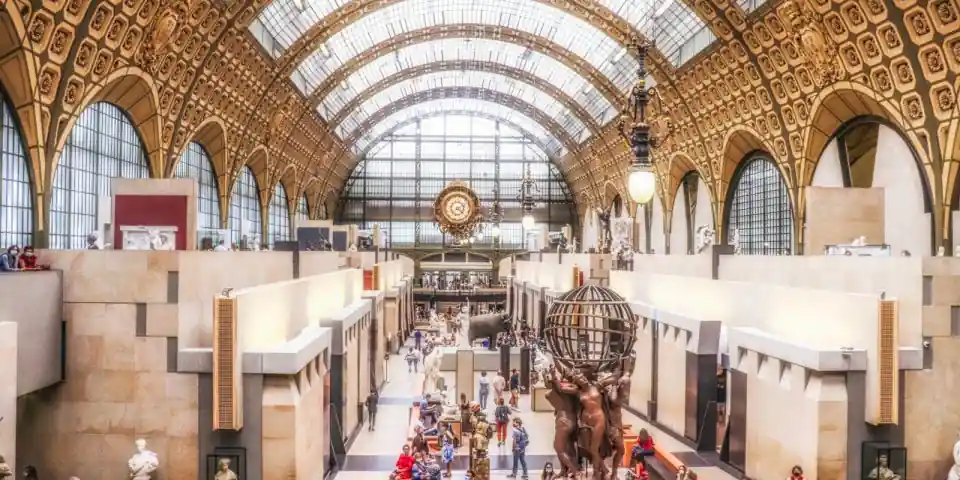
The Essential Musee d'Orsay Tour
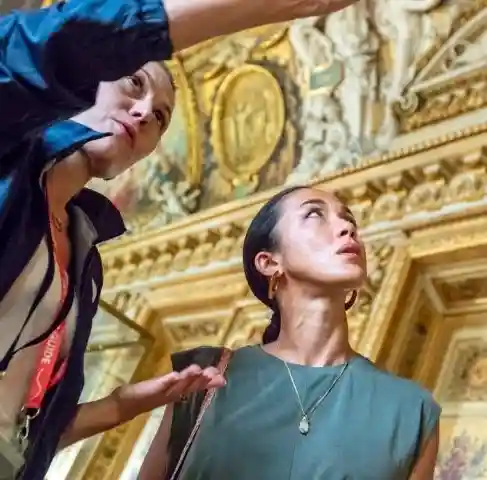
The Musée d'Orsay has the world’s leading Impressionist collection. This guided tour focuses on works by Monet, Degas, and Van Gogh and the stories behind them.
Impressionist Highlights
This is the heart of the Musée d'Orsay collection, with the paintings most visitors come to see first. Monet, Renoir, and Degas define these rooms, with Manet's work close by as a starting point for what follows.
 Renoir's Bal du Moulin de la Galette
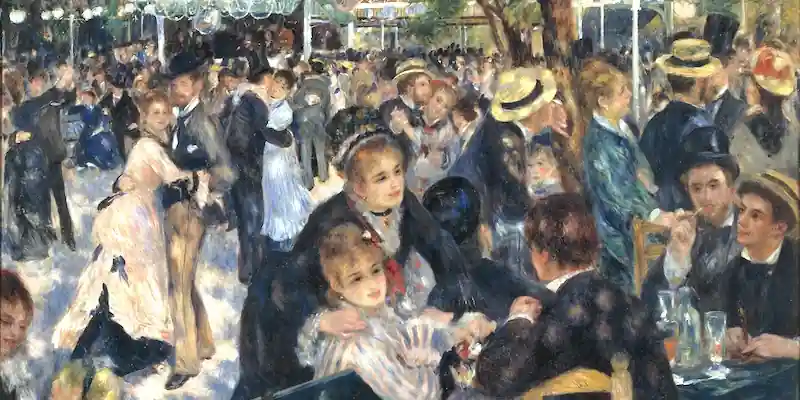
Renoir – Bal du moulin de la Galette
Renoir's Dance at Le Moulin de la Galette captures a crowded afternoon in Montmartre, with figures gathered under shifting light and shadow. It's one of the largest and most closely viewed paintings in the museum, and it works best when you step back and take in the full scene.
Manet – Olympia
Manet's Olympia still stops people in their tracks, just as it did when it first appeared in 1865. The direct gaze, the stark lighting, and the subject itself broke with expectations at the time and set the stage for the painters who followed.
Monet – Coquelicots
Monet's Poppies is one of the most familiar images in the museum, with its loose brushwork and bright red fields set against an open sky. The painting shifts attention away from detail and toward color and light, which is what defines much of the work in these rooms.
Degas – La Classe de danse
Degas's The Ballet Class shows dancers at work rather than on stage, arranged at different angles across the room. The composition feels informal, as if you've walked in during rehearsal, which is part of what makes it so distinctive.
Morisot – Le Berceau
Berthe Morisot's The Cradle offers a quieter moment, focused on a mother watching over a sleeping child. The soft tones and close framing give it a very different presence from the larger, more crowded scenes nearby.
Claude Monet
Claude Monet is at the center of the Musée d'Orsay collection, with a group of paintings that show how his work developed from open landscapes to studies of light and atmosphere over time. These are among the most closely viewed paintings in the museum, and often the ones visitors come specifically to see.
Many visitors continue beyond the museum with a day trip to Giverny, where Monet's house and gardens shaped much of this work. For a closer look at the paintings in this museum, see our guide to Monet at the Musée d'Orsay.
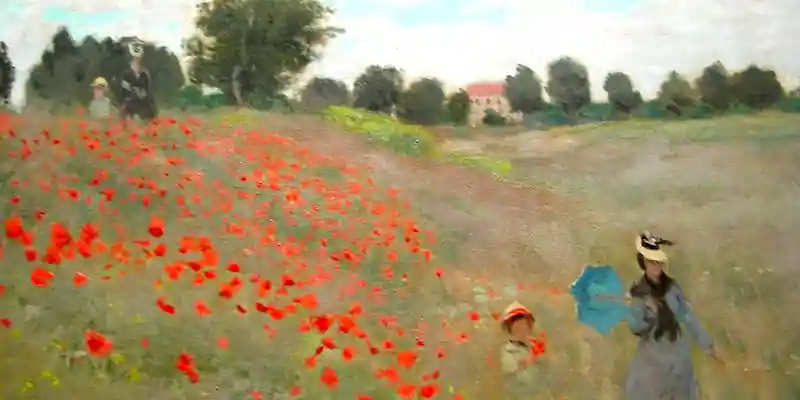 Monet's Poppies (Coquelicots), Musée d'Orsay"
Monet – Coquelicots (Poppies)
Coquelicots is one of Monet's most recognizable paintings, with its loose brushwork and bright red fields set against an open sky. The scene is simple, but the shifting light and movement give it depth.
Monet – Gare Saint-Lazare
The Gare Saint-Lazare paintings bring modern Paris into Monet's work, with steam, iron structures, and light filling the station. They stand apart from his rural scenes and show how he approached the city itself.
Monet – Nymphéas Bleus (Blue Waterlilies)
Nymphéas Bleus shifts the focus to surface and reflection, with water, sky, and plant life blending together. It points toward the later works at Giverny, where the subject becomes almost entirely about light and color.
Monet – Le Déjeuner Sur l'Herbe (Luncheon on the Grass)
Le Déjeuner Sur l'Herbe reflects Monet's early ambitions, with a large-scale composition that draws on earlier traditions while moving toward a looser, more modern approach. It's perhaps less finished than his later work, but still revealing.
Monet – Rue Montorgueil, à Paris, Fête du 30 juin 1878
This street scene, depicting festivities on Rue Montorgueil, is filled with flags and movement, capturing a moment of celebration in Paris. The loose brushwork and bursts of color give the painting its energy, with the crowd suggested rather than defined.
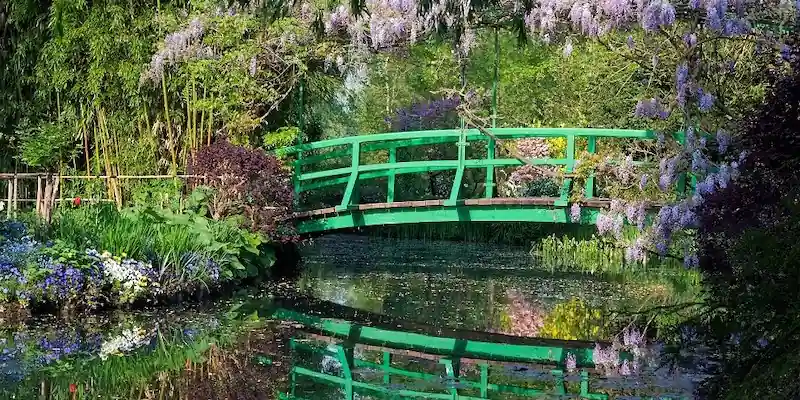
A Day Trip To Giverny From Paris
Visit Monet's house and gardens at Giverny, where he painted and found inspiration for works now at the Musée d’Orsay. Step into the paintings' setting.
Vincent van Gogh
Van Gogh's paintings are among the most sought after in the museum, with a small number of works that draw steady crowds. They sit slightly apart from the Impressionist rooms, with a more direct, personal style that's easy to recognize. For a closer look, see our guide to Van Gogh at the Musée d'Orsay
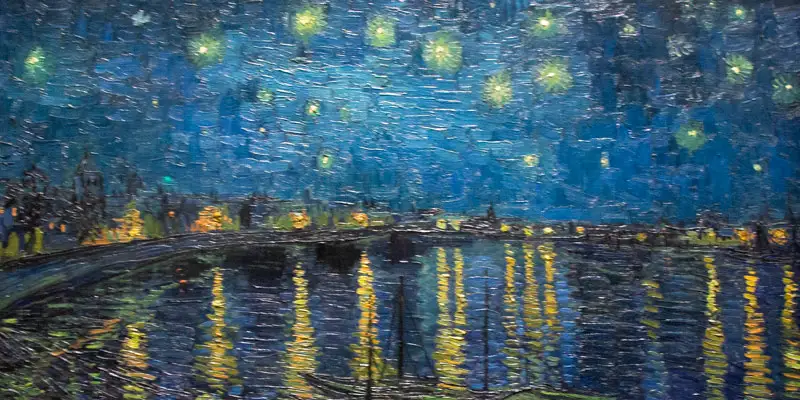 Van Gogh's Starry Night Over the Rhone
Van Gogh – La Nuit étoilée
Starry Night Over the Rhône is the best-known of these, with deep blue tones and reflections of light across the water. The scene seems calm at first, but the brushwork and color give it a tension that sets it apart.
Van Gogh – Autoportrait (1889)
Van Gogh painted a series of self-portraits, and this one stands out for its directness, with the face set against a flat, lightly worked background. The brushwork is visible and deliberate, especially in the hair and jacket, and the expression is steady rather than dramatic, which makes the painting feel more controlled than some of his later work.
Van Gogh – L’Église d’Auvers-sur-Oise
Church at Auvers shows a shift in his later work, with heavier outlines and a more unsettled composition. The building itself feels slightly unstable, which gives the painting its distinctive energy.
Before Impressionism and After
Before the Impressionists, painters like Manet and Courbet were already breaking with tradition, turning away from historical subjects toward modern life and direct observation. Their work sets the stage for what follows in the rest of the museum. For more, see our guide to Manet at the Musée d'Orsay.
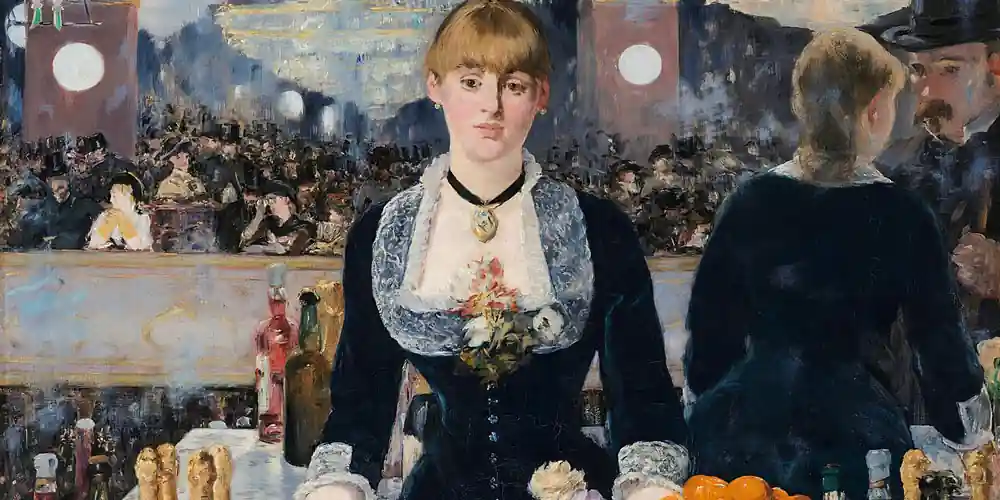 Édouard Manet's Un Bar aux Folies-Bergère
Manet – Un Bar aux Folies-Bergère
A Bar at the Folies-Bergère shows a barmaid standing before a mirror that reflects the crowded interior behind her, creating a composition that feels both direct and slightly disorienting. It's one of Manet's most complex works.
Manet – Le Déjeuner sur l'Herbe
Le Déjeuner sur l'Herbe places contemporary figures in a setting that recalls classical painting, but without the expected conventions. The contrast between subject and style is part of what made it so controversial. Monet later painted his own version of the same subject, taking the idea in a very different direction.
Courbet – Un enterrement à Ornans
Courbet's A Burial at Ornans takes an ordinary provincial funeral and treats it on a monumental scale, giving everyday life the weight usually reserved for historical scenes. The figures are presented without hierarchy, which was unusual at the time.
Gauguin – Et l'Or de Leur Corps
Gauguin's Et l'Or de Leur Corps moves further away from realism, with flattened forms and stronger color taking precedence over observation. It points toward the direction painting would take after Impressionism.
What Most Visitors Miss
Beyond the well-known works, a few paintings are easy to be overlooked,either because they're quieter, smaller, or simply not as immediately recognizable. They're often less crowded, and worth a few extra minutes.
 Caillebotte's Les Raboteurs de parquet
Caillebotte – Les Raboteurs de parquet
The Floor Scrapers focuses on workers in a Paris apartment, shown at close range without idealization. The subject and perspective both set it apart from the surrounding paintings.
Degas – L'Absinthe
L'Absinthe shows two figures seated at a café table, with a sense of distance between them that's hard to ignore. The composition is simple, but the mood is what stays with you.
Pissarro – Le Boulevard Montmartre, effet de nuit
Pissarro's view of Boulevard Montmartre captures the city after dark, with streetlights and movement suggested through loose brushwork. It's easy to pass by, but it worth a closer look.
Sisley – L'Inondation à Port-Marly
Sisley's flood scenes show water spreading through streets and buildings,with a calm, measured treatment that contrasts with the subject itself. The balance between structure and reflection is what holds the painting together.
Morisot – Jour d'été
Summer's Day places two women in a small boat on the water,with the background reduced to color and movement. It's a lighter scene, but no less deliberate in its composition.
Plan Your Visit
START WITH:
Find Your Hotel In France
Sleep among the vineyards, beside the Mediterranean, or in the heart of a historic French city. Find highly-rated hotels for your travels beyond Paris.