







The Population of Paris – From 50 AD To The Present
From its beginnings as a small Gallic village along the Seine, Paris has grown into one of the most densely populated cities in the world, with 20,000 people per square kilometer. For visitors from less crowded places, this density can feel intense, but it's part of what gives Paris its vibrant, dynamic character. Remarkably, though, the city was even more crowded a century ago.
Paris reached its population peak around 1920, with nearly three million people living within its central boundaries — the area now enclosed by the Périphérique and home to the city's seventeen arrondissements. Today, the population of central Paris stands at 2.2 million, while the broader Paris metropolitan area has grown to over 12 million residents, a testament to the city's enduring appeal and importance.
Find Your Hotel In France
Traveling beyond Paris? Find good places to stay across France, from city neighborhoods and vineyard hotels to Riviera hideaways and small-town inns. Compare locations and see what's open for your travel dates.
History of the Population of Paris
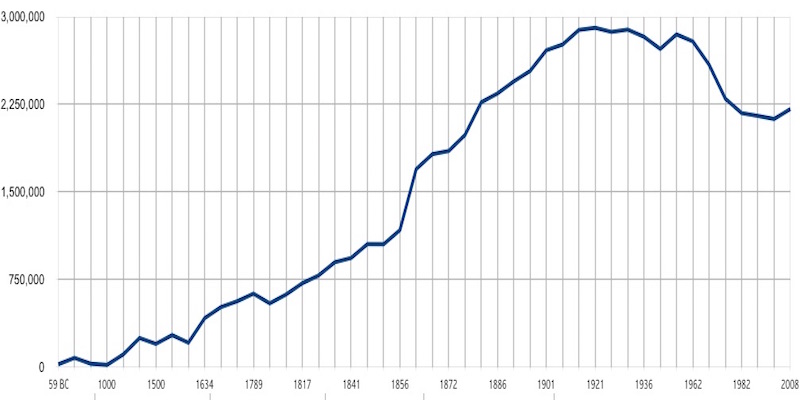
The story of Paris's population begins with the Celtic settlement that occupied a convenient crossing on the Seine. In those early days, the population numbered only a few thousand. Under Roman rule, Paris expanded into the commercial hub of Lutetia, controlling river traffic and crossings. At its height, Roman Paris housed around 80,000 people, a significant number for the time.
After the fall of the Roman Empire and waves of invasions in the 3rd and 4th centuries, the population dwindled to about 30,000, continuing to decline during the Viking raids of the 9th century. By the turn of the first millennium, the population had dropped to just 20,000.
Population in the Middle Ages
Paris began its true ascent during the Middle Ages, becoming Europe's largest city and, by 1550, the largest in the world. However, this growth was not without setbacks. The Black Plague and the Hundred Years' War took a heavy toll, significantly reducing the population during those turbulent times.
By the reign of Henry IV in the early 17th century, Paris had rebounded spectacularly, with the population exceeding 400,000. From that point, growth continued steadily, boosted by major expansions of the city boundaries in 1860 and the sweeping urban renewal carried out under Napoleon III and Baron Haussmann. These transformations cemented Paris's status as one of the world's great cities and laid the foundation for the bustling metropolis we know today.

Louvre Guided Tours
The Louvre is vast, and a good guide makes the visit easier. See the Mona Lisa, the Venus de Milo, and other highlights while hearing how this former royal palace became the world’s most visited museum.
Population In The Modern Era
In 1920 the population of Paris was of 2.9 million, and the population density was a staggering 69,000 people per square mile. In later years, the population declined slowly but steadily until it reached a modern low point of just over 2.1 million in 1990. Since that time Paris has slowly regained population to reach its present size of something over 2.2 million.
IN that period there have been major population shifts among the Paris arrondissements. All of the low-numbered arrondissements (1 to 11) have declined in population in the modern era, while the high-numbered arrondissements have grown in population. The difference is often dramatic —
| Area | 1872 | 2009 |
| 1st Arrondissement | 74,286 | 17,767 |
| 2nd Arrondissement | 73,578 | 21,955 |
| Marais: 3rd & 4th Arrondissements | 184,690 | 62,496 |
| 9th Arrondissement | 103,767 | 59,840 |
| 13th Arrondissement | 69,431 | 184,034 |
| 15th Arrondissement | 75,449 | 238,914 |
| 16th Arrondissement | 43,332 | 171,880 |
| 19th Arrondissement | 93,174 | 186,507 |
| 20th Arrondissement | 92,772 | 196,678 |
Today the highest and lowest populations are the 1st at 17,767 versus the 15th at 238,914. The population density runs from 25,000 people per square mile in the 1st to 109,000 in the 11th. (In 2020 the 1st through 4th Arrondissements were combined into a single urban administrative district named Paris Central, partly because of the relatively small number of people who reside there — a combined total of about 100,000.)
Paris Planning Guides
 Top Montmartre Hotels
 |
 Book an Airport Transfer
 |
 Visiting Versailles
 |
 Glorious Dinner Cruises
 |
Discover What's On When You're Here• May 2026 Things to Do…• June 2026 Things to Do…• July 2026 Things to Do…• August 2026 Things to Do…• Month-by-Month Calendar… |